Showing posts with label doing things. Show all posts

Sunday, April 23, 2017

April Marches

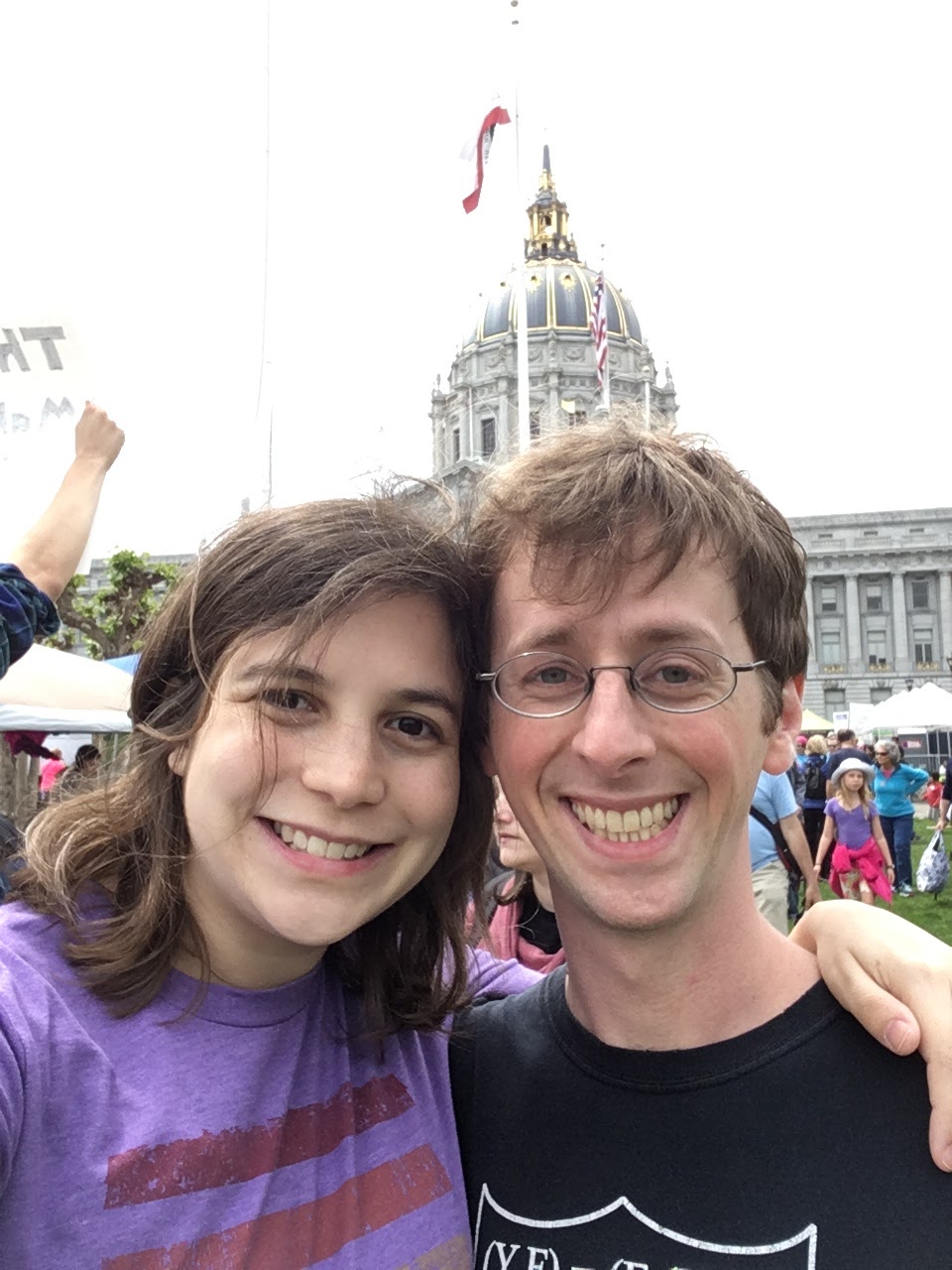
Baby is due in two weeks, so I'm trying to get in as much civic engagement as I can before she shows up and I disappear into the newborn void for a while. I helped host two fundraisers for Jon Ossoff with two different groups of friends in the past month, and have been continuing to use 5calls to call various government people each weekday morning. Last weekend Ben and I went to the SF Tax March:

And yesterday we went to the SF March for Science:

Both marches followed the same route through the city, but it was noticeably more difficult yesterday (at 38 weeks pregnant) than the week before. We'll see if I'm still pregnant and in marching shape next weekend for the People's Climate March...

Sunday, January 22, 2017

Small victories

I'm trying to stay focused on what I want to work towards in the coming four (and God forbid eight) years, instead of despairing over all the things there are to work against. In that spirit, here are three and a half things I am happy about this weekend.

First and foremost, my feminist reading group was matched with an Afghani refugee family via the IRC earlier this week. We set up an Amazon registry for everything they'll need for their new apartment, and a GoFundMe for the rent subsidy we'll be providing them. We posted both links on Thursday. By Saturday, 100% of the registry was purchased and we had exceeded our GoFundMe target. There's still a lot of work to do to set up their apartment, and even more to support and mentor them as they make the transition to America, but this is a great start that has me feeling renewed faith in and gratitude for my community.

Second, the picture of the Obamas I ordered a few weeks ago finally came! Now I get to look at them on my way out the door each morning - I pretend Michelle is personally reminding me to "go high" as I start each day.

Third, yesterday we went to the Women's March on San Francisco, and it always feels great to be with friends and surrounded by a massive horde of excited people who agree with you :)

Although, while at the Women's March I couldn't help but think about a Black Lives Matter protest I went to a few years ago in the exact same part of SF. That was a small weeknight protest, with 30 protestors max standing on the sidewalk. There were at least 50 police officers in full riot gear there, and they stood shoulder to shoulder encircling the protest. At the Women's March yesterday there were over 100,000 protestors shutting down the street for over a mile, but the police were only stationed every few blocks. They were wearing regular uniforms and casually chatting with each other and with protestors. The difference in police presence and behavior was startling, even knowing what I know about how police treat protestors of color versus white protestors. It was a stark reminder that I need to keep showing up, and bringing my protective whiteness along with me. I hope I'm able to keep doing so once the baby comes.

Three and a half - this isn't really my thing to be happy about, but as I write this post Ben is at a training for "White Men for Racial, Gender and Economic Justice," along with another white male friend of ours. Neither of them were particularly active before the election, although they both supported equality, but now they are both looking to become more active in pushing for what they believe in. I am hopeful that there are many, many more people out there finding themselves in the same situation, so that the momentum of yesterday's march carries through to meaningful social change.

Sunday, January 1, 2017

Goodbye 2016

I didn't write anything here for the last two months of the year because I was really depressed about the election. I was also in the early months of being pregnant, and while the pregnancy is great news, I was sick most of the time so wasn't really doing anything besides struggling through the workday, lying on the couch, trying not to throw up, and throwing up. The election and the pregnancy sort of swirled together into a seemingly endless stream of nausea and existential dread - we had been thrilled about the pregnancy on November 7, but then a switch flipped and both Ben and I really struggled with what it's going to mean to bring a child into a world that is much different, and much worse, than the one we had anticipated.

After a mourning period (no kidding - I wore a torn black ribbon for a week after the election to symbolically sit shiva), I owned up to the fact that as rich, well-educated, straight, cis, white people living in an extremely liberal area, we are going to be among the least harmed by the new administration. That means we need to step up to try and minimize the damage to the more vulnerable among us. So far we've done that by:
  • Increasing our recurring donations from 5% of our income to 10%, partly by increasing the amount to organizations like the ACLU and Planned Parenthood, whose work is now more important than ever, and partly by adding a few new organizations that address the increasingly urgent issues of Islamophobia (Council on American-Islamic Relations), immigrant rights (National Immigration Law Center), voting rights (Brannan Center for Justice), and trans rights (TGI Justice Project).
  • I found out I get a bonus at my new job, which is great but financially unnecessary, so I gave it away. Some went to extra end of year giving for organizations we already support, most went to organizations working to support Syrian refugees given the current severity of that crisis.
  • The feminist book club I'm a part of decided to do more than just read together, and collectively we are sponsoring the local resettlement of a refugee family with the International Rescue Committee. Unfortunately the US doesn't let citizens sponsor the settlement of additional refugee families, so we can't increase the number of people receiving safety here, but the IRC works to support the settlement of already approved refugee families who don't have any local friends or family to support them. We should be matched with a family in the next few weeks, at which point we'll raise funds to support them financially, collect furniture and other items to furnish their new home, and mentor them in navigating the city, getting jobs, getting their kids enrolled in school, and all the other tasks that they'll need support in managing over the coming months.
  • I've been calling various elected representatives every morning on my walk to work to advocate for and against various bills, proposals, and appointments. I get my daily action list from a combination of We're His Problem Now, #FightTrump, and Wall of Us. At first I was reluctant to do this because I don't like talking to strangers on the phone, but it is actually really easy, and now it's just part of my morning routine. For the first few weeks I was calling while walking, I was still stopping behind what I nicknamed my "puke bush" midway through my walk for my daily morning throw up, and I was still able to make calls before and after - it really is that easy. One time Jason Chaffetz even answered his own phone, which I was totally unprepared for, but the lesson I took away was to keep calling and be prepared to talk to anyone.
  • This is a small thing, but we sent handwritten support letters to every mosque that received hatemail after the election. It felt nice to write uniformly positive and loving letters, in contrast to the often critical phone calls, and the unexpected - but completely lovely - result has been some incredibly wonderful letters back from people at the various mosques. So if you're ever visiting and wonder why we have holiday cards from random mosques across the country on our fridge, that's why.
  • Ben has been especially concerned about the potential environmental harm on the horizon, so he's been figuring out how to make us greener in various ways. For now he's mostly focused on reducing our water use and our trash output, and we've also agreed to only eat meat twice a week, fly less often, and do as much of our shopping locally as possible.
  • We're not going to go to the Women's March on Washington, as part of our new "minimize flying" policy, but we are going to go to the Bay Area solidarity march.
  • I re-read "Uprooting Racism: How White People Can Work for Racial Justice" with a group at work, and we're trying to figure out how we can collectively do something useful like my feminist book club is doing.
  • I also read "Hope in the Dark: Untold Histories, Wild Possibilities" and found it really helpful for thinking about how to approach the coming years. In particular, I'm realizing the importance of picking only 1-2 issues and really focusing on them, rather than trying to do everything and doing it all poorly. The author also writes about the importance of centering your actions around the goals you are trying to achieve, and not developing an unhealthy obsession with "the enemy" standing in your way. In other words, I need to resist the temptation to waste mental energy despairing over how awful the human dumpster fire of the president elect is, and stay focused on loving and supporting the people I want to protect from him.
All told, I'm feeling okay about what we are doing so far (and I haven't stopped doing any of the things I've written about in previous posts). I'm having to resist the temptation to join more groups and sign up for more recurring actions, because I know I'll have limited capacity once the baby comes, and I don't want to start any work where me suddenly disappearing for several months would cause problems. I am feeling kind of icky about the fact that all of these actions we're taking would have still been important had the election gone the other way, but we probably wouldn't have been catalyzed into doing them. I'm hoping the unpleasantness of that personal realization will compel me to maintain this level of engagement even when there isn't a looming existential threat to our national freedom and security.

Sunday, July 24, 2016

Doing things: Showing up

I've written before about showing up with your money for racial justice, but it's also important to show up with your body. What this means will be different for different people based on their individual abilities, interests, schedule constraints, and resources, but it's important to figure out how you can contribute and then show up accordingly, especially if you are white. When we are publicly silent and/or passive about issues of racial injustice, regardless of what we are thinking in our own heads or discussing privately with people who already agree with us, we are tacitly giving our approval to the injustice at hand, and thereby reinforcing it. No one person or action will fix generations of white supremacy overnight, but even as an atheistic Jew I try to follow the rabbinic saying that "you are not obligated to complete the work, but neither are you free to desist from it."

And from a purely selfish perspective, when the world feels especially terrible like it has been feeling recently, physically going out and doing something about it feels good, as does meeting and building community with other people committed to social justice.

What I've been doing so far:
(Note - this is a long list of things, but I have slowly added these actions to my life over the past five or six years, and I am not always doing all of these things simultaneously. I don't want anyone to look at this list and think I am spending every waking moment doing all of these things - as you know from reading this blog, I still have plenty of time for other activities.)
  • Voting! I mean, duh. It is worth mentioning that we don't just vote in the presidential elections, though - we vote in off-cycle elections too, and we do research in advance so we can be informed in voting for roles like city councilman, state legislators, etc... Those local roles get a lot less attention and a lot fewer votes than the big national ones, but they tend to impact people's day-to-day lives a lot more. Usually about a month before each election, I google something like "Philadelphia ballot November 2015" to get a list of everything that will be on the ballot. Then I search for info on each candidate and ballot initiative in order to make a decision about how to vote for each one- usually Ben does half the research and I do half.
  • Attending protests and rallies. I'm not able to go to as many as I like due to the combination of my work schedule and how long it takes to get between locations in the Bay, but I try to go when I can. I've been to the 50th Anniversary March on Washington, various Black Lives Matter protests and vigils back in Philly and here in the Bay, and most recently a Jews Reject Trump vigil (where we got a nice sign that now sits in our front window). I know how I would feel if a group I was a member of was being executed in the street with legal impunity, or had a presidential candidate saying we were less than human and should be treated accordingly, and no one from other groups showed up to protest and demand better. That's why it's important for me to show up as white person to events that publicly decry white supremacy in all its forms. I follow my local Showing Up for Racial Justice group to find out about upcoming actions (they also have a good guide for showing up as a white person at events led by people of color), as well as my local Black Lives Matter group.
    • Sidenote: One of my earlier childhood memories is my mom bringing me and my sister along to protest my hometown celebrating it's 250th anniversary with a giant reenactment of a Confederate ball that happened there during the Civil War. I remember understanding why we were there, and feeling both mad that something unfair was happening and proud that we were trying to stop it. I also remember there being almost no other white people there, and wondering why that was since my hometown was majority white, and surely everyone else also knew celebrating our town by reenacting a party for slave owners and defenders of slave owners was wrong, right? I share this story to illustrate both the importance of white people showing up for racial justice, and that bringing kids along can help them feel empowered and internalize values of fairness, justice, and speaking out when you see something wrong is happening. There have been kids of all ages at every protest and rally I have gone to thus far, so their presence is very normal.
      • Side sidenote: That ball still gets reenacted annually, although as a private event and not a city government-sponsored one.
  • Volunteering. In Philly I volunteered with Big Brothers Big Sisters, since moving to the Bay I've been volunteering with organizations that need more episodic support, since I'm not sure how long we'll live here (the plan is only a few years) and I don't want to form another deep emotional bond with an individual kid that I'll have to leave (although me and my Philly little sister still stay in touch, and I see her whenever I'm back in town). The two groups I've been volunteering with out here are Black Girls Code, since they have a lot of weekend events that need various support roles, and the Bay Area Childcare Collective, which is a collective of mostly white people who provide free childcare for grassroots organizations led by women of color so they can plan and carry out their work while knowing their kids are being well taken care of. It's great because both organizations let me hang out with awesome kids so that the people who should be leading this work can do what they need to do. I found both groups just by googling around for Bay Area volunteer opportunities and various keywords that I was interested in (i.e. "youth" and "racial justice"), and then reaching out to the relevant people and asking how I could help.
  • Making phone calls when I am asked. For example, most recently the police arrested over a hundred peaceful Black Lives Matter protestors in Baton Rouge (that's where this now-iconic photo came from), so organizers asked people to call the jail where they were being held to ask why they were arrested and demand their safe treatment and immediate release. Making this type of call is probably the quickest and easiest thing you can do, and you don't even have to get dressed or stand up to do it. I find out about these requests by following organizers like DeRay Mckesson and Brittany Packnett on Twitter.
  • I also consider speaking up about racial justice to be a form of showing up, but I've written a separate post about that already, so I won't go over it again here.
What I'm committing to do in the future:
  • The biggest thing I want to do is figure out how to get more involved in pushing for legal changes beyond just voting. That means using Campaign Zero's take action tool to figure out which of my representatives to contact about supporting what legislation that works to end police violence, and then contacting them about it and continuing to contact them about it until it passes.
  • I'm also considering taking unpaid leave in October to go canvass for HRC and/or a get out the vote campaign, if the polls are looking anywhere near close. I just can't imagine telling my kids that a straight up white supremacist was running for president (and won??), and I didn't do anything about it besides feel anxious and really hope he doesn't win.
What else do people do? Especially in recent months nothing feels like enough, so I am always looking for new ideas!

Sunday, February 14, 2016

Doing things: Times to speak up, and times to listen

Background: The MIT class ring is called the brass rat, and it is a Big Deal amongst MIT people. You get your ring at the end of your sophomore year, so wearing one around campus is a status symbol that you are at least halfway through your MIT education. You flip it around at graduation and forever after, so wearing a flipped brass rat is an even bigger status symbol - you have an MIT degree! There is a lot of pomp and circumstance surrounding the ring, starting with the "ring premier" partway through your sophomore year - each class has a "ring committee" that updates the design to reflect that specific graduating class's time at MIT, and that design is revealed at the premier. Starting with the class of 2002 there has been a push to include a woman in the MIT seal on the ring, but despite women making up nearly half of the undergraduate population it took until the class of 2017 to get another woman on the seal (happily the 2018s followed suit, so hopefully it will stick). Supporters of the two-men seal claim that they aren't supporting the exclusion of women, but the continuance of "tradition" - which is bullshit for many reasons, not the least of which is that the seal has been altered in a variety of ways over the years (like placing a remote control in the pocket of one of the seal people for the class of 2006) with no "tradition!" outcry. Also, any time you are defending something solely on the basis of "that's the way we've always done it," you need to dig deeper to figure out what you are really saying, since "tradition" can be, and often is, used to justify the continuation of all sorts of oppression long past the point when one can plausibly deny awareness of the issue (SAE, anyone?).

***

I was beyond excited for my class's ring premier. I look young for my age and was dying to soon have wearable, undeniable proof that I not only was an MIT student (and not a visiting high schooler, as I often got mistaken for), but I was (at least) halfway through my time at the Institute. Plus, like most 19-year-olds would be, I was dying for a status symbol that my particular community valued highly. I would finally have a tangible piece of evidence that I belonged with the cool kids.

My classmates and I dressed up for the premier, and applauded with delight as each successive component of the ring was revealed. I was waiting with bated breath for the revelation of the seal, because I was convinced that our class would finally include a woman - it was 2006, for chrissakes! But when the big moment finally came, they revealed a seal with two men - in fact, they specifically used the term "unadulterated" to describe it. Apparently the inclusion of someone like me would have been an adulteration - would have made it "weaker by adding something of poor quality."

For a split second I felt crushed, but then my disappointment turned to confusion as I noticed the rest of the audience reacting. Men, not all of them but a lot of them, all around me were on their feet cheering. Not just cheering - pumping their fists in the air, whooping, and hollering with excitement. It was like being in the stands at a sporting event when the home team scores, but the unbridled enthusiasm was because people like me were excluded. I felt a new feeling in the pit of my stomach, one that I had never felt before. A minute ago I had been comfortably surrounded by my peers, feeling very much a part of the MIT community. Now a large part of that community was triumphantly celebrating that I had been kept out of a cherished part of our shared culture, and I felt sick. I dimly noticed some students walking out - mostly women but some men as well - but I was too surprised and confused to join them. To this day I still very much regret that I didn't.

(Technically our ring has a woman on it, because it has Athena, goddess of wisdom, in the courtyard in another section. But if you believe that - despite the fact that she is separate, a quarter the size of the men (plural), and standing out in the yard instead of at the dais - she is still somehow equal, then we have a 1954 supreme court decision to talk about.)

MIT is a very male-dominated place, and I had been made to feel my otherness in many small ways over my first two years there - the two most common were people thinking I was there to visit my brother or boyfriend, and other students telling me it was easier for me to get in because I was a girl. It had been easy to brush off those incidents, and even laugh at them, because I thought they were anomalies - little leftover shards of a dying patriarchal culture whose heyday had long since passed. My ring premiere was the first time it was forcefully revealed to me that the belief that people like me didn't fully belong was much more pervasive and deeply held than I had realized, and it was the first time in my life I had been made to feel that way. After all, I'm a cis, straight, white, thin, able-bodied woman from an affluent neighborhood and with a great education - I very comfortably belong in the vast majority of places that I go. That brief glimpse of what it feels like to be marginalized, and to have your exclusion not just tolerated but celebrated by people you had liked and respected, was an eye-opening moment for me. As was the continuing delegitimization of my feelings by many of my male friends, who told me I was being too sensitive, reading too much into nothing, and - like most women who voice their feelings - crazy. In some ways, that denial of my experience hurt worse than the initial insult itself - I vividly recall the pain of a previously-trusted male hallmate telling me to stop complaining about nothing. We are still in the same social circles but I have never felt the same way about him since.

I tell this story today because my womanhood is often how I connect to and seek to more deeply understand other forms of oppression. I can never claim to understand what it feels like to be a person of color in this country, because my white privilege so far outweighs my oppression as a women given all the other forms of identity privilege I listed above. But moments like the ring premier and the conversations I had after it - and moments like when I was at the movies and the row of men behind me couldn't stop laughing at an anti-rape PSA (because apparently trying to prevent rape is hilarious), or when I was in the park and and a group of men near me kept catcalling a group of women marching against sexual assault - give me slivers of insight into what daily life is like for so many people in this country.

What stands out to me the most about all of those moments is not the small number of men committing the offense, but the large number of men watching what was happening and doing nothing. That is the real staying power of systemic oppression - not that some members of the dominant group occasionally make their power visible in ugly ways, but that the rest of the dominant group lets inertia prevent them from interfering. It is not the responsibility of the oppressed to intervene and educate the people who are oppressing them, and oftentimes doing so is not even a possibility for them. I felt physically unsafe in that movie theater and at that park; there was no way I was going to approach those men and ask them to stop. The ones with the power to dismantle oppression are the members of the dominant group, and - just like Spider-Man - having that power gives them the responsibility to do so.

The way I wanted men to disrupt other men during the moments I talked about here (and so many others) - that's the way I need to disrupt my fellow white people when I see them perpetuating racism, and my fellow cis people when I see them perpetuating transphobia, and my fellow straight people, and able-bodied people, and... And the way I wanted my male friends to actually listen to what I was trying to tell them about something that was painful and difficult for me - that's the way I need to listen when a person of color trusts me enough to tell me about a painful confrontation they had with racism, even if I was the one who caused the hurt. I don't need to explain away what happened by talking about good intentions, or alternate interpretations, or hyper-sensitivity. I need to listen, empathize, apologize when necessary, and above all else be grateful for their trust in me, knowing how hard it is for me to openly talk about my experiences with sexism with most men given how often it is met with denial.

For me at least, I often times don't speak up when I see something happening because I feel like I don't know how. But there are a lot of resources out there on how to effectively challenge oppressive moments and how to tell someone they sound racist, and letting my fear of making a fool of myself prevent me from fulfilling my responsibility to disrupt oppression is just another way of accepting the oppressive status quo. My silence legitimizes the power of systemic oppression, and makes me complicit in perpetuating it.

I still wear my brass rat every single day, no longer because I need the world to know that I went to MIT, but because when I look at it I remember that pit in my stomach nearly a decade ago. I remember how my silence forces other people to spend most of their lives with their stomachs in that pit. And while I don't always speak up when I should, and I don't always get it right when I do speak up, I wear the ring like Spider-Man would wear a locket of Uncle Ben. I have power to disrupt oppression, and that means I have the responsibility to do so.

Sunday, May 10, 2015

Doing Things: Putting my money where my mouth is

Money is power. White people stole resources, labor, and land from people of color to build the US before it was even the US, and in the intervening centuries there has been a continuous stream of policies, both official and unofficial, that maintain and strengthen the unequal distribution of wealth between white people and people of color (read The Case For Reparations if you need a refresher). That means white people have the most economic power in the US, and part of dismantling white privilege is acknowledging that reality and working to change it. It's good and important to learn more, as I've been working to do, but just learning and caring abstractly is pretty meaningless if I don't actually use my privilege to do something about it. I hear a lot of white people try to opt themselves out of this part of the work because their family wasn't here "when all that happened" and/or because they worked hard to get what they have, and I've already written about why that's not a "get out of white privilege free" card, so today I'm going to focus on what I'm trying to do with my money.

What I've been doing so far:
  •  I set aside a certain percentage of my paycheck to give away. The percentage has changed over time as my paycheck and financial situation has changed, but my philosophy is that more disposable income = give more of it away. However, I don't believe in giving "to charity" - I try to give "in solidarity." Here's a great talk on the difference between the two concepts - the summary is that "charity" is for the people it claims to serve, while "solidarity" is with them. Charity is giving money to an organization that feeds the homeless, solidarity is giving money to an organization run by formerly homeless people that fights for policies to end homelessness. A lot of nonprofits are somewhere in the middle and are not purely one or the other, but in general I try to give to organizations run by the people impacted by the injustice they seek to address. Different people care about different issues, but here are the organizations that I have a recurring contribution set up for:
    • First Nations Development Institute - a Native-run nonprofit that works towards Native economic empowerment through a combination of training, advocacy, and direct financial grants.
    • Partners In Health - PIH's mission is to provide health care to the world's poor, but it does so by training local people and establishing self-sustaining community health centers, instead of just periodically parachuting in with medicine and foreign doctors. They also focus on addressing the conditions of poverty that impede health, since the best health care in the world isn't very helpful if you don't have access to things like food and clean water. It was founded by Paul Farmer, who is both a doctor and an anthropologist, and everyone should read his book.
    • Black Girls Code - founded by a Black female electrical engineer, BGC introduces programming to young girls of color so they have access to the STEM professions that will allow them to be the tech innovators and leaders of the future.
    • The Food Trust - though it has since expanded across the country, the Food Trust started in Philadelphia, where they continue to work with local communities to ensure access to healthy food in schools and neighborhoods that are often known as "food deserts." They've done lots of great stuff here, like working to make sure SNAP ("food stamps") can be used at farmers markets so SNAP users can access local, fresh produce.
    • Lambda Legal - they use a combination of education, litigation, and public policy advocacy to work towards full civil rights for LGBTQ people and people with HIV.
  • In addition to the organizations that I make regular contributions to, I also set aside money for more acute situations. Lately that means I've been contributing money to fundraisers for things like Michael Brown's family's legal costs (that campaign was funded so the link no longer works) and bail and legal support for Baltimore protestors. My job makes it hard for me to show up to protests as often as I would like, but it also means I can afford to contribute financially to support those who are able to be there in person.
  • This is a small thing, but I try to prioritize which movies I pay to see in theaters and which movies I watch months later online for less money or for free. Specifically, I try to prioritize paying to see movies made by people of color and movies with people of color in leading roles, because I want those movies to make money so more movies like them get made. For example, this year I only had time to see one of the Oscar nominated movies in a theater, so I picked Selma. There have been a lot of studies showing that diverse movies make more money, so hopefully over time the profit motive will lead to more diverse media.
What I am committing to doing in the future:
  • The biggest thing I want to get better about is being more purposeful about where I spend my money as a consumer. I already do a lot of the easy things and avoid spending money at companies who do particularly shitty stuff with their profits, e.g. Chik-Fil-A (even though I know every giant/successful company does at least some shitty stuff, and no one can avoid all of it). What is harder to do, though, is purposefully spend money at businesses run by people of color - because all of the issues I talked about up top make it harder for people of color to found businesses in the first place. Still, the internet has been great for this purpose - both because shopping online gives you access to a bigger variety of shopping options, and because there are websites that help you find POC-run businesses to patronize locally. I'm committing to doing my research when I need to buy things, hire people for services, etc... and, whenever possible, to choose an option run by people of color. One thing I am proud of about where I work is that when we have conferences, we purposefully patronize restaurants/catering companies run by people in the communities where we place teachers - so I want to hold myself to that same standard.
  • We're moving to the Bay Area this summer for Ben's new job at google, and we both have mixed feelings about it - we are excited for Ben's job, but can't deny the destruction that tech-driven rapid gentrification has done to communities of color in the area. Not that gentrification doesn't happen in other cities too, or that there are cities we could move where we wouldn't be gentrifiers, but it has had particular speed and voraciousness in the Bay because of Silicon Valley - and now we are moving there and becoming part of it. We're trying to be really purposeful about planning how we will live there so we don't cause further harm, and as much as possible try to mitigate the harm that has already happened. This list and this list have been helpful starting points - in terms of finances, we are committing to spending our money at local, POC-owned businesses as much as possible, adding some SF-based organizations to the recurring contributions list, and not living in a place where previous occupants were evicted or foreclosed on because of increasing prices. Ben is also going to buy a transit pass even if he ends up taking the "google bus" to work, because we'll be living in a city and taking advantage of all the great stuff it has to offer, and that means we contribute to its public infrastructure even if we have the privilege of opting out.

Thursday, February 5, 2015

Doing things: At work

My last post about my efforts to better use my privilege generated an unexpected (and welcome!) number of people emailing me with suggestions for additional reading (including one excellent comic) and/or interest in reading and learning along with me. I'm really happy that others are interested in doing this work with me - but now I also have a lot of reading to do! While I'm working on that, I'm going to also focus on doing things besides reading. Today's theme is doing things at work - not necessarily the actual work that I do, but the way I do that work. I share the below not to pat myself on the back for being such a great person, but because it’s been a difficult, multi-year process for me to get to where I currently am – with lots of people pushing me to get better, and lots of mistakes on my part – so I want to share what I’ve learned, as well as what I’m doing to get better.

What I have done so far:
  • When I had the opportunity to hire someone for the first time a few years ago, I did what most hiring managers do and started asking around in my networks for candidate recommendations. I got a lot of suggestions, but I noticed that they were all very similar to me - young, straight, cis, white women from middle class backgrounds who attended great schools and whose strengths were primarily in analytics and operations. I already had one of me on my team, so I didn't want to hire another one. I started reaching out to a broader swath of people and groups for recommendations - e.g. I asked the African American Managers affinity group, and I asked teacher coaches about their teachers about to finish their two-year commitment (since the role was entry level and so someone could be competitive for it straight out of the classroom). I ended up being able to build a very diverse applicant pool, so when I found the person I wanted to hire I felt confident she really was the best person for the role, not just the best person in my immediate network. Hiring in this way is important both because it makes it more likely that you get the strongest talent, and because hiring only within your networks is one of the ways that privilege is consolidated and protected. In the words of that study's author, "most white Americans engage, at least a few times per year, in the activities that foster inequality. While they may not deliberately discriminate against black and other non-white job seekers, they take actions that make it more likely that white people will be employed -- without thinking that what they're doing amounts to discrimination."
  • Creating a diverse team is not a useful end goal, though, because numeric diversity is worthless if your workplace isn't also inclusive (everyone feels safe, welcome, able to be themselves, etc...) and equitable (people have equal access to knowledge and power, input into decisions that affect them, etc...). When I hired someone who had a different background from me in so many ways, and who had a completely different set of skills and growth areas, I was nervous that I wouldn't be able to manage her in a way that allowed her to really thrive. I only knew how to manage someone who worked the same way I do, and I was afraid that in trying to manage her to work like me I would quash her ability to work like herself, and in turn stifle her ability to really contribute to the team. I asked a white colleague who manages a diverse team, and has really high staff satisfaction and engagement, for recommendations, and she suggested I read The Inclusion Paradox. It can be a little self-help-y at times, but it was really helpful in terms of being very concrete about what to do to foster an inclusive work environment.
  • The most helpful thing I learned was "the seven dimensions of culture." The basic idea is that there are seven big cultural ways people often vary in how they approach their work and their lives, and problems arise when one way is taken to be the only right way. For example, one of the dimensions is how people manage time - there is a spectrum from synchronous (very flexible with regards to timing and deadlines) to sequential (very focused on punctuality and having deadlines for everything). I am undoubtedly way at the sequential end at the spectrum, but until that was called out for me, I didn't even realize it was a cultural preference - I just thought it was inherently The One Correct Way Of Operating At Work. The person I hired is much more on the synchronous side of things. When she first started, we actually went through all seven dimensions and diagnosed ourselves, then talked about where there were discrepancies and how we would handle them - without automatically assuming that either way of operating was right or better. It was really helpful to have a common language and shared framework to guide our early conversations about how we work most effectively. Now we work really well together - we align on when something does have a non-negotiable timing/deadline component for a specific reason, and when something can be more flexible. Of course, there are still occasional bumps along the way that make one of us wonder what the heck the other one is thinking/doing, so we sometimes have to revisit our earlier conversations to figure out what is/isn’t working and how we can adjust moving forward. In general, I've found that operating in this way with everyone I work with, not just people I directly manage, has led to a lot of benefits - for example, I have been in many meetings that reached the scheduled end time but the conversation wasn't finished. Before I would have just ended them because the time was up, but now I ask if folks don't mind staying a few extra minutes to wrap up. We often are able to land in a much better place as a result, and we avoid having to schedule an entire follow-up meeting to resolve something that only took a few more minutes. Being inclusive makes work better for everyone!
What I'm committing to do next:
  • My biggest growth area is in making sure my team is not just inclusive, but actually equitable. Do the people who are most affected by my decisions have a seat at the table while I'm making them? I recently discovered Chris Crass's Tools for White Guys who are Working for Social Change… and other people socialized in a society based on domination, which is a very concrete checklist for just this task. I have printed it out at my desk and am trying to be much more conscious of dynamics at work, particularly when I am in a position of power (due to my title, my race, my education, my class, or any combination of the above). It's really hard, and it can be painful to realize that I have been dominating discussions or hoarding power in ways that I didn't even realize. But at the same time I can already feel it making me better as a person and helping me to operate in a more equitable way. It's definitely something I will need to continue to be conscientious about so long as I am alive, it's not a list to check off once and then be done, but I'm hoping to get to the point where I've internalized it and it's much more automatic for me to operate in this more equitable way. And just like a more inclusive culture is better for everyone, a more equitable culture makes work better both in terms of how it feels, and the actual quality of work that gets done.